
Halloween Candy Activities for Speech and Language Fun

Halloween decorations are popping up in all the stores right now. Spooky! And all the Halloween candy your little ones are about to acquire? Potentially even spookier!
Instead of letting that candy sit around, let’s turn it into something fun.
Think back to those moments when you got home after trick-or-treating and dumped your bucket (or pillowcase!) full of candy onto the floor. The excitement of seeing what you got, comparing your stash with your siblings and friends, and deciding which candy you wanted to eat first was half the fun.
Now, let’s take that familiar activity one step further and turn it into a fun Halloween speech and language activity—without your little one even realizing they’re practicing language skills!
And if you're looking to do this activity outside of Halloween (or your candy has already been eaten!) no problem! You can use pretend candy, play food, or even pictures of candy. You can still target all of the same speech and language skills.
Why Kids Love This Activity
It’s real life!
Kids are naturally motivated by the things and experiences happening around them. Using familiar activities makes it easier to practice skills in a way that feels meaningful and fun.
Sorting candy also provides a hands-on experience that feels more like play and less like “speech therapy.” It gives your child opportunities to hear and use language while connecting with the people and world around them.
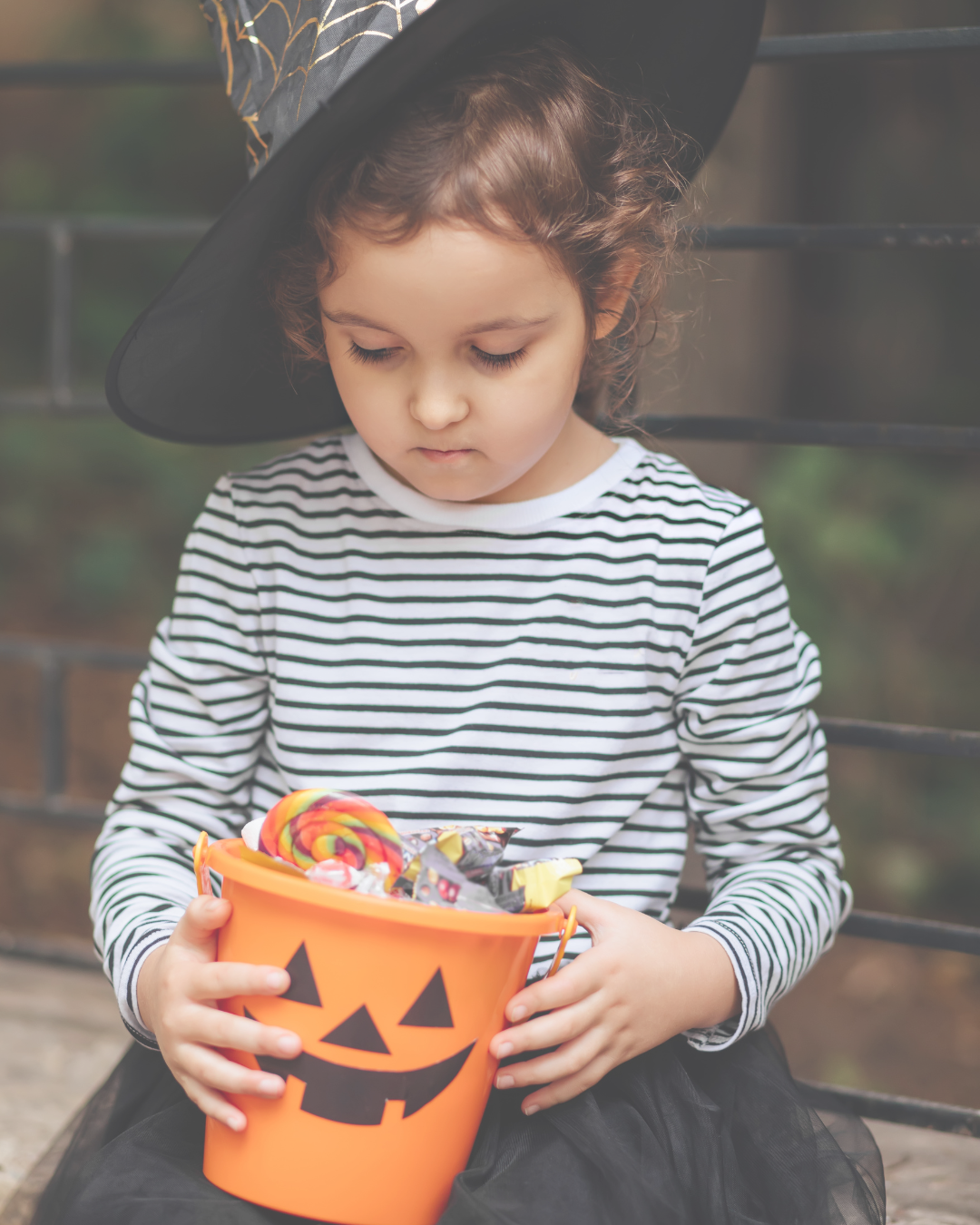
So, what speech and language skills can you work on with a pile of Halloween candy?
Build Vocabulary
Halloween candy is a great way to build and practice vocabulary. Have your child pick one—or a few—of their favorites and talk about different characteristics.
You can describe: color, shape, size, flavor, texture, and type.
For example, you might say: “This candy is red, small, chewy, and sour.”
Want to take this one step further? Compare two different candies. Choose something like a chocolate bar and a sour candy and talk about how they are alike and different.
You could talk about:
Sweet vs. sour
Hard vs. soft
Big vs. small
Smooth vs. bumpy
Different colors
Different shapes
Different types of wrappers
You can even ask your child to tell you one way the candies are the same and one way they are different.
And we won’t tell if you sneak in a bite to make sure you have all of your candy facts down pat!
Practice Following Directions
Candy can also be a fun and motivating way to practice following directions.
If your child is working on one-step directions, start simple: “Find the red candy.”
Once your child is ready for more of a challenge, try two-step directions: “Find the chocolate candy and put it in the bowl.”
You can also introduce directions that include concepts such as size and location: “Put the small candy next to the big candy.”
As your child becomes more comfortable, increase the complexity of your directions by adding more steps: “Find the red candy, put it next to the chocolate candy, and then give me the small one.”
If your child has difficulty when there are lots of pieces of candy out at once, put some away! Reducing the visual field can make it easier for your child to focus on the direction and find success.
Practice Categorization
Have your child sort the candy into different groups. This is an easy way to work on categorization and language skills during a familiar activity.
You could sort candy by:
Chocolate vs. non-chocolate
Small, medium, and large
Color
Shape
Type of candy
Hard vs. soft
Sweet vs. sour
Color of the wrapper
You can even make the activity more challenging by changing the sorting rule.
For example, first ask your child to sort all of the candy by color. Once they finish, mix everything back together and ask them to sort the same candy by size. This encourages your child to think flexibly and recognize that objects can belong to different categories depending on the characteristic you are focusing on.
Play a Halloween Candy Guessing Game
Here’s a game to try!
Think of it as Headbandz… without the headbands.
You and your child each secretly pick a piece of candy without letting the other person see. Then, take turns asking yes-or-no questions to try to figure out which candy the other person chose.
Questions could include:
“Is it chocolate?”
“Is it sweet?”
“Is it hard to chew?”
“Does it have a brown wrapper?”
This simple game gives your child opportunities to practice asking questions, answering questions, describing, using vocabulary, listening, and reasoning. And if your child needs some help coming up with questions, that’s okay! Model one for them and let them try it themselves.

Looking for More Speech and Language Activities?
If you’re looking for more easy ways to support your child’s communication skills at home, check out our other speech and language activities for kids.
More Fall-Themed Activities:
When Should I Be Concerned About My Child’s Speech and Language Skills?
If your child is having difficulty with vocabulary, following directions, answering questions, or communicating with others, consider discussing your concerns with a speech-language pathologist (SLP). Whether you’ve noticed something at home or your child’s teacher has raised a concern, an SLP can help you understand your child’s communication development.
You don’t have to wait until you’re certain there is a problem to reach out. At OWLS Therapy, we offer free phone consultations where we can talk through your concerns, answer your questions, and discuss what next steps may be appropriate for your child.
Give us a call today—we’re here to help!